SALMON, Idaho (Reuters) - A cow that escaped last week from a Montana slaughterhouse, leading workers and police on a six-hour chase, will be spared following a wave of popular support, officials said on Tuesday.
Del Morris, manager of Mickey's Packing Plant in Great Falls, said he decided to let the cow live the instant he saw it cross the Missouri River through Great Falls.
Town residents will now decide through a telephone poll whether the cow will remain a resident of Montana, where it will live out its life on pastureland surrounding the packing plant, or be shipped to an animal sanctuary in Seattle.
Morris said the heifer he calls Molly and her escape effort attained celebrity status with television and news organizations requesting interviews and calls pouring in from across the country and overseas.
"I've been around cattle all my life and it's just totally amazing," Morris said, adding that it is a rare cow that escapes slaughter. "I watched her do things that are just not possible for a cow."
1/11/2006
When good things happen to good cows..


Report from Captain Obvious: Angelina Jolie Expecting Baby
LOS ANGELES - Angelina Jolie is expecting a baby this summer with Brad Pitt, according to a report on the People magazine Web site.
"Yes, I'm pregnant," the magazine quoted Jolie as telling charity aid worker Monday in the Dominican Republic, where she is filming "The Good Shepherd" with Matt Damon.
The report says the pregnancy was confirmed by representatives of both stars but does not identify them by name.
The news comes one month after papers were filed to make Pitt the adoptive father of Jolie's two children. Jolie sought to change the names of the children to Zahara Jolie-Pitt and Maddox Jolie-Pitt was filed.
Pitt accompanied Jolie to Ethiopia in July to pick up Zahara, now 1 year old. Jolie's son, now 4 years old, was adopted from Cambodia.
Pitt and actress Jennifer Aniston announced their separation last January, and Aniston filed for divorce in March, citing irreconcilable differences. The divorce became final in October.
Pitt, 42, has denied Jolie, 30, was behind the split.
Jolie, a goodwill ambassador for the U.N. High Commissioner for Refugees, recently toured quake-devastated areas in Pakistan with Pitt. She met with Pakistani President Gen. Pervez Musharraf and toured a town largely destroyed by the Oct. 8 earthquake that killed an estimated 86,000 people.
Update on Cy:poor little thing.
By TERRENCE PETTY, Associated Press Writer
PORTLAND, Ore. - A photo of a one-eyed kitten named Cy drew more than a little skepticism when it turned up on various Web sites, but medical authorities have a name for the bizarre condition.
"Holoprosencephaly" causes facial deformities, according to the National Institute for Neurological Disorders and Stroke, part of the National Institutes of Health. In the worst cases, a single eye is located where the nose should be, according to the institute's Web site.
Traci Allen says the kitten she named Cy, short for Cyclops, was born the night of Dec. 28 with the single eye and no nose.
"You don't expect to see something like that," the 35-year-old Allen said by telephone from her home in Redmond in central Oregon.
Allen said she stayed up all night with the deformed kitten on her recliner, feeding Cy a liquid formula through a syringe. She says she cared for the kitten the next day as well, until it died that evening.
Allen had taken digital pictures that she provided to The Associated Press. Some bloggers have questioned the authenticity of the photo distributed on Jan. 6.
AP regional photo editor Tom Stathis said he took extensive steps to confirm the one-eyed cat was not a hoax. Stathis had Allen ship him the memory card that was in her camera. On the card were a number of pictures — including holiday snapshots, and four pictures of a one-eyed kitten. The kitten pictures showed the animal from different perspectives.
Fabricating those images in sequence and in the camera's original picture format, from the varying perspectives, would have been virtually impossible, Stathis said.
Meanwhile, Cy the one-eyed cat may be dead, but it has not left the building.
Allen said she's keeping the cat's corpse in her freezer for now, in case scientists would like it for research.
She said one thing's for certain: "I'm not going to put it on eBay."
1/10/2006
This is truely bizarre

so sad poor little creature...
Cy, short for Cyclopes, a kitten born with only one eye and no nose, is shown in this photo provided by its owner in Redmond, Oregon, on Wednesday, Dec. 28, 2005. The kitten, a ragdoll breed, which died after living for one day, was one of two in the litter. Its sibling was born normal and healthy.
Human Skin-Bound Books in Many Libraries ...oh how tres Gothique!
By M.L. JOHNSON, Associated Press Writer
PROVIDENCE, R.I. - Brown University's library boasts an anatomy book that combines form and function in macabre fashion. Its cover — tanned and polished to a smooth golden brown, like fine leather — is made of human skin.
In fact, a number of the nation's finest libraries, including Harvard's, have such books in their collections. The practice of binding books in human skin was not uncommon in centuries past, even if it was not always discussed in polite society.
At the time, the best libraries belonged to private collectors. Some were doctors who had access to skin from amputated parts and patients whose bodies had gone unclaimed. In other cases, wealthy bibliophiles acquired skin from executed criminals, medical school cadavers and people who died in the poor house.
Nowadays, libraries typically keep such volumes in their rare book collections and do not allow them to circulate. But scholars can examine them.
Brown's John Hay Library has three books bound in human skin — the 1568 anatomy text by the Belgian surgeon Andreas Vesalius, and two 19th-century editions of "The Dance of Death," a medieval morality tale.
One copy of "The Dance of Death" was rebound in 1893 by Joseph Zaehnsdorf, a master binder in London. A note to his client reports that he did not have enough skin and had to split it. The front cover, bound in the outer layer of skin, has a slightly bumpy texture, like soft sandpaper. The spine and back cover, made from the inner layer, feel like suede.
"The Dance of Death" is about how death prevails over all, rich or poor. As with many other skin-bound volumes, "there was some tie-in with the content of the book," said Sam Streit, director of the John Hay Library.
Similarly, many of the volumes are medical books. The College of Physicians of Philadelphia has some books bound by Dr. John Stockton Hough, who diagnosed the city's first case of trichinosis. He used that patient's skin to bind three of the volumes.
"The hypothesis that I was suggesting is that these physicians did this to honor the people who furthered medical research," said Laura Hartman, a rare-book cataloger at the National Library of Medicine in Maryland and author of a paper on the subject.
In most cases, universities and other libraries acquired the books as donations or as part of collections they purchased.
It is not clear whether some of the patients knew what would happen to their bodies. In most cases, the skin appears to have come from poor people who had no one to claim their remains. In any case, the practice took place well before the modern age of consent forms and organ donor cards.
While human leather may be repulsive to contemporary society, libraries can ethically have the books in their collections if they are used respectfully for academic research and not displayed as objects of curiosity, said Paul Wolpe of the Center for Bioethics at the University of Pennsylvania.
"There is a certain distancing that history gives us from certain kinds of artifacts," Wolpe said, noting that museums often have bones from archaeological sites. "If you had called me and said these are books from Nazi Germany, I would have a very different response."
The Boston Athenaeum, a private library, has an 1837 copy of George Walton's memoirs bound in his own skin. Walton was a highwayman — a robber who specialized in ambushing travelers — and left the volume to one of his victims.
The Cleveland Public Library has a Quran that may have been bound in the skin of its previous owner, an Arab tribal leader.
Decades ago, the Harvard Law School Library bought a 1605 manual for Spanish lawyers for $42.50 from an antiquarian books dealer in New Orleans. It sat on a shelf unnoticed until the early 1990s, when curator David Ferris was going through the library catalog and found a note saying it was bound in a man's skin.
DNA tests as to whether it is human skin were inconclusive — the genetic material having been destroyed by the tanning process — but the library had a box made to store the book and now keeps it on a special shelf.
"We felt we couldn't set it just next to someone else's law books," Ferris said.
___
On the Net:
John Hay Library
Boston Athenaeum
College of Physicians of Philadelphia:
Creamy Spinach Pasta
Like its cousin, fettucine Alfredo, this warm dish is rich - but it sure makes it easier to get children to eat their vegetables. INGREDIENTS:
3/4 cup butter
1 clove garlic, minced
3 tbsp. chopped onion
3/4 lb. fresh or frozen spinach, drained and coarsely chopped
1 lb. green or white fettucine noodles
1-1/2 cups grated Parmesan cheese
1 cup heavy cream
Pepper
1. In a medium-sized skillet, melt half the butter and add the garlic and onion. Cook until golden but not browned. Add the spinach and partially cover the pan until the spinach had heated through.
2. Meanwhile, cook the noodles according to the package directions. Drain the pasta and return it to the pot. Toss it with the remaining butter, the spinach mixture, cheese, and cream until all are blended and heated through.Makes 6 servings.
OMG too cool...I'm gonna make these:) -Armadillo Potatoes
INGREDIENTS:
1/4 cup bread crumbs
1/4 cup grated Parmesan cheese
1 tablespoon paprika
Salt and pepper to taste
Olive oil
6 Idaho potatoes, peeled and cut in half lengthwise
1. Heat the oven to 450°. In a bowl, mix together the bread crumbs, cheese, paprika, salt and pepper, and 1 tablespoon of olive oil. Set the mixture aside.
2. Transform each potato half into an armadillo by cutting 9 or so notches 1/2 to 1 inch deep in the rounded top. For each armadillo, cut a square of aluminum foil big enough to loosely wrap around it, brush the center with olive oil, then place the potato on it, flat side down. Sprinkle the top with some of the crumb mixture, pressing it into the grooves, then seal the potato in the aluminum foil.
3. Arrange all of the foil-covered potatoes on a baking sheet and bake them for 40 to 45 minutes. Open the pouches carefully ? they will be hot and full of steam. Makes 1 dozen armadillos.
Dad's Macaroni and Cheese
Homemade mac and cheese is simple and yummy -- and tons of fun to eat! INGREDIENTS:
8 oz. uncooked wagon wheel pasta
3 tbsp. butter
3 tbsp. flour
1 3/4 cups milk
2 cups shredded cheddar
2 tbsp. grated Parmesan
1 tsp. Worcestershire sauce
1/2 tsp. salt
1/4 tsp. pepper
3 tbsp. chopped canned jalapenos, optional
1. Cook pasta in large pot of boiling, salted water. Drain.
2. Meanwhile, melt butter in a medium saucepan over medium heat. Stir in flour and cook for 1 minute. Gradually stir in milk. Cook until the sauce is thickened, stirring constantly, about 3 minutes.
3. Add cheeses, Worcestershire sauce, salt and pepper. Cook and stir until cheese melts. Stir in cooked pasta and jalapenos, if desired. Makes 6 servings.
Grandma Urbanski's Potato Pierogi --YUM!
INGREDIENTS:
Dough
4 cups all-purpose flour
1 teaspoon salt
1 cup plus 2 tablespoons cold water
3 large egg yolks
Potato Filling
4 medium-size all-purpose potatoes, peeled and cut into small chunks
2 tablespoons butter, plus extra for frying
1 small onion, finely chopped
1/4 - 1/2 cup grated cheddar cheese, or slightly more, to taste
Salt to taste
1. To make the dough, combine the flour and salt in a large mixing bowl.
2. Make a well in the center and add the water and egg yolks. With a wooden spoon, stir constantly until the dough holds together, adding a little more water if necessary.
3. Turn the dough onto a lightly floured surface and knead it for 2 minutes. Put the dough back in the bowl, cover it with plastic wrap, and set it aside.
4. For the filling, boil the potatoes in a large saucepan of salted water for about 10 minutes or until the potatoes are soft.
5. Drain the potatoes, then mash them by hand.
6. Meanwhile, melt 2 tablespoons of butter in a small skillet. Add the onion and sauté for 5 minutes, stirring often.
7. Add the onion, cheese, and salt to the potatoes and mash them in.
8. Bring a large pot of salted water to a boil.
9. Meanwhile, break the dough into quarters. Roll one out thin on a floured surface.
10. Using a biscuit cutter or a water glass, cut the dough into 3 to 3 1/2-inch circles. Roll out and cut the scraps. Repeat with the other 3 quarters until all the dough is used.
11. Put a heaping teaspoon of filling in the center of each circle.
12. Moisten the edge of the circle with a wet fingertip, then fold it in half and press the edges together firmly to seal.
13. Drop the pierogi, 8 to 10 at a time, into the boiling water. Simmer until the pierogi rise to the surface, then continue to simmer for 4 to 5 minutes more.
14. Next, melt a little butter in a large skillet. Using a slotted spoon, transfer the pierogi from the water into the skillet. Cook them in the butter over medium high heat for several minutes, until lightly browned on both sides.
15. Serve hot and garnish with a little extra cheese, if you like. Makes 4 to 5 dozen.
1/09/2006
Tristan and Isolde, a love story.
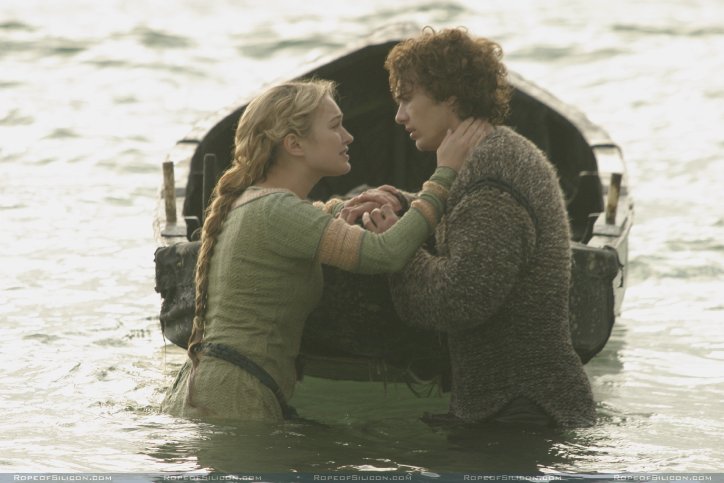
oh goodie a new Medieval movie coming out!!
In the medieval legend of Tristan and Isolde, young lovers become doomed against the forces of royal politics. English knight Tristan wins the hand of the daughter of the Irish King, but the love threatens the truce between their two countries.
Genres: Drama and Romance
Release Date: January 13th, 2006 (wide)
MPAA Rating: PG-13 for intense battle sequences and some sexuality.
Distributors: Twentieth Century Fox
| Your Stipper Song Is |
 Master and Servant by Depeche Mode "There's a new game We like to play you see A game with added reality You treat me like a dog Get me down on my knees" Yawn, dancing is so boring without a little spice. |
1/07/2006
Brain Protein May Be Linked to Depression
WASHINGTON - Scientists have discovered a protein that seems to play a crucial role in developing depression, a finding that may lead to new treatments for the often debilitating illness — and fundamental understanding of why it strikes.
Although problems with the mood-regulating brain chemical serotonin have long been linked to depression, scientists don't know what causes the disease that afflicts some 18 million Americans — or exactly what serotonin's role is.
The newly found protein, named p11, appears to regulate how brain cells respond to serotonin, researchers from Rockefeller University and Sweden's Karolinska Institute report Friday in the journal Science.
"We're all very excited about this discovery," said Nobel laureate Paul Greengard, a Rockefeller neuroscientist who led the research. "People have been looking for modulators of serotonin for a long time."
Said Oxford University pharmacologist Trevor Sharp, who reviewed the work: "This finding represents compelling evidence that p11 has a pivotal role in both the cause of depression and perhaps its successful treatment."
Most depression medications used today are members of the Prozac family that work by making more serotonin available to brain cells. They stem from a theory that depression patients might not have enough serotonin, a neurotransmitter, or chemical that carries signals between nerve cells.
Then scientists discovered the serotonin connection was more complicated, dependent on how well the neurotransmitter binds to receptors, or docking ports, on cell surfaces. Fourteen different serotonin receptors have been discovered.
The new research focuses on one of those receptors, dubbed the "1B" receptor, that seems to play a particularly big role in major depression.
Greengard and colleagues discovered that the p11 protein increases the numbers of these receptors on the surfaces of cells, mobilizing them so they're available for serotonin to do its job.
That led to a series of remarkable experiments, using mice as well as brain tissue saved from the autopsies of depressed patients, that found:
_Depressed people have substantially lower levels of p11 in their brain tissue than the non-depressed. So did a breed of mice, called "helpless" mice, that exhibit depression symptoms.
_Then the mice were given two older antidepressants — one known as a tricyclic, the other an MAO inhibitor — and electric shock therapy. Each treatment increased the amount of p11 in mice brains, even though each therapy is known to work in different ways.
_So the researchers bred mice that had no p11-producing gene. They acted depressed, and had fewer 1B receptors and less serotonin activity than regular mice. They also were less likely to improve with depression medication. Mice genetically altered to produce extra p11 acted in just the opposite way — no depression-like behavior, and their brain cells carried extra serotonin-signaling receptors.
"It's a very important finding," said Dr. Thomas Insel, director of the National Institute of Mental Health, which funded the research. "This gives us a new set of targets for drug development," but also "suggests a whole new area of investigation for trying to ... ultimately discover does this have anything to do with why some people get depressed and others don't."
The researchers don't yet know whether a genetic defect or some other factor is responsible for altering p11 levels.
"The p11 is upstream of the receptor, and now the question is what is upstream of the p11," Greengard said.
But Sharp noted that bouts of depression often are associated with serious stress, and that p11 is part of a protein family known to be sensitive to certain stress-related hormones.
Greengard's lab now is researching the potential for p11-related therapies.
But the discovery likely will aid research into other diseases that also depend on cell-based receptors.
"We're finding that other molecules control other receptors, so I think this may open up quite a major new area of approach to developing therapeutic drugs," Greengard said.
___
Irish bog man liked to slick back with hair gel
LONDON (Reuters) - The preserved remains of two prehistoric men discovered in an Irish bog have revealed a couple of surprises --- one used hair gel and the other stood 6 foot 6 inches high, the tallest Iron Age body discovered.
"He would have been a giant...the other man was quite short, about 5 foot 2 inches," said Ned Kelly, head of antiquities at the National Museum of Ireland.
"The shorter man appeared to attempt to give himself greater stature by a rather curious headdress which was a bit like a Mohican-style with the hair gel, which was a resin imported from France," Kelly told BBC radio.
Bacterial conditions found in the peat bogs preserved the remains so that even fingerprints were clearly visible.
The fashion-conscious gel wearer has been named Clonycavan Man and Kelly said the fact he was able to buy imported cosmetics suggests he was a wealthy member of Irish society about 2,300 years ago. The other was dubbed Oldcroghan Man.
Kelly said both men had murdered.
"Oldcroghan Man was stabbed through the chest. He saw that attack coming because there is a defensive injury on his arm."
He was then decapitated and his body cut in half while Clonycaven Man had his head split open with an axe before he was disemboweled.
Dog Deaths Surpass 100 Despite Toxic Pet Food Recall
At least 100 dogs in the United States have been killed in recent weeks by toxic pet food despite a recall of the products, scientists said today.
Some 19 brands of Diamond, Country Value and Professional dog foods have been recalled. But many pet owners are not aware of the recall, researchers at Cornell University said Friday.
Dogs have refused to eat the food and, in some cases, their owners have enticed them with gravy and other lures without knowing they were killing the animals.
"Entire kennels have been wiped out, and because of the holiday these past few weeks, the dispersal of recall information was disrupted," said Sharon Center, a professor of veterinary medicine who specializes in liver function and disease at the College of Veterinary Medicine at Cornell.
The dog food is tainted with deadly aflatoxins that waste the liver away. The bad food could be present in a dozen other countries, too, the researchers say. About two-thirds of dogs that show symptoms from the toxin have died.
The dogs seemed to know their food was deadly.
"Some dogs were stealing food from the kitchen counter," Center said. "Others just stopped eating the food and begged for treats. Unfortunately, some owners used gravy and other mixers to entice their dogs to consume what they thought was safe, quality dog food."
Only about two dozen deaths have been firmly linked to the tainted pet food. But Center and her colleagues know the toll is far higher.
"Every day, we're hearing reports from veterinarians in the East and Southeast who have treated dogs that have died from liver damage this past month or so," Center said. "We're also concerned about the long-term health of dogs that survive as well as dogs that have eaten the tainted food but show no clinical signs."
Surviving dogs may develop chronic liver disease or liver cancer, she said.
"Despite our understanding of this complex toxin, we have no direct antidote," Center said.
Symptoms arise over days or weeks. Early signs include lethargy, loss of appetite and vomiting. Later, look for orange-colored urine and jaundice, which is a yellowing of the eyes and gums. Severely affected dogs produce a blood-tinged vomit and bloody or blackened stools.
This is so sad, poor pups...Expert Blames Dog Disease for Wolf Decline
This to me is really upsetting , the poor little wolves, parvo is an awful thing, horrible for any canine to have....I just had to post this , our old stomping grounds, up Yellowstone way, MT, WY...
BILLINGS, Mont. - Most of the gray wolf pups born in Yellowstone National Park last year have died, possibly because of a dog disease, a federal wolf expert says.
Just 22 of the 69 pups born last year are still alive, said Doug Smith, the park's wolf project leader. That's the biggest drop in pup numbers since wolves were reintroduced to the park 11 years ago. The greatest toll was seen on the park's northern range, where only eight of the 49 pups born last spring survived.
"It's cause for concern, a great deal of concern," Smith said.
During the next few weeks, he said, officials plan to catch Yellowstone wolf pups and take blood samples to see if his suspicions about the disease, parvo virus, are true. The disease can cause extreme diarrhea and dehydration and kill more vulnerable animals, like young pups.
Though vaccinations are an option — many domestic dogs receive them — Smith said it would be difficult in the park.
"It requires two vaccinations to build up an immunity, and we'd have to catch every wolf," he said. "Both those things are impractical."
If parvo virus is confirmed, there is little officials can do besides monitor the population and hope exposed wolves build a natural immunity to the disease, he said.
The state's wolf program leader also suspects parvo virus is behind the deaths. Carolyn Sim said her suspicions are based on den-site monitoring and whether pups emerge in summer with their packs.
State wildlife officials plan to collect blood from wolves — possibly even from carcasses dead 24 hours or less — as part of their disease surveillance, she said.
Terry Kreeger, supervisor of veterinary services for the Wyoming Game and Fish Department, said that while parvo virus could have a noticeable effect for years on wolf populations like Yellowstone's, he doesn't believe it will be devastating.
It could, however, have implications for how wolves are managed, Smith said. The number of wolves in Yellowstone dropped last year from 171 to 118, he said. The largest single-year drop before that was 11 from 1998-99, when parvo virus also was suspected, he said.
The gray wolf is federally protected, but Wyoming officials are seeking more control over the predators amid complaints from farmers and ranchers who say the growing wolf population poses a threat to wildlife, livestock and pets.
Montana recently took over most management duties within its borders, and Idaho signed an agreement with the Interior Department on Thursday to do the same.
Two Stations Won't Air 'Book of Daniel' - I think this looks funny , we'll be watching:)
NEW YORK - Two television stations are refusing to broadcast a new NBC series about an Episcopal priest who abuses painkillers, has a gay son, a promiscuous straight son, a daughter who deals marijuana, and a wife who drinks too much.
Conservative Christian groups have condemned the depiction of Jesus as blasphemous, accusing the writers of portraying Christ as tolerant of sin in talks with the priest.
NBC affiliates KARK in Little Rock, Ark., and WTWO in Terre Haute, Ind., said sensitivity to viewers led them not to air "The Book of Daniel," which debuts Friday. In Little Rock, the WB affiliate has arranged to show the drama instead.
"If my action causes people in our community to pay more attention to what they watch on television, I have accomplished my mission," Duane Lammers, WTWO's general manager, said in a statement on his station's Web site.
The series stars Aidan Quinn as the Rev. Daniel Webster, who discusses his many troubles in regular chats with a robe-wearing, bearded Jesus. The American Family Association, in Tupelo, Miss., and Focus on the Family, the Colorado Springs group led by James Dobson, are asking supporters to lobby their local NBC affiliate to drop the show.
In a statement Thursday, NBC said, "We're confident that once audiences view this quality drama themselves, they'll appreciate this thought-provoking examination of one American family."
But the American Family Association said the series was another sign of NBC's "anti-Christian bigotry." Bill Donohue, president of the Catholic League, an anti-defamation group, called the series the "work of an embittered ex-Catholic homosexual."
The show's creator and executive producer, Jack Kenny, said he drew on the emotionally guarded family of his male partner for the series. He said his goal was to depict how "humor and grace" help a flawed man struggle with his faith and family. He said the writers never meant to mock religion or Jesus.
However, Bob Waliszewski, of Focus on the Family's teen ministries, said the show portrayed Christ as a "namby-pamby frat boy who basically winks at every sin and perversity under the sun."
"When the pastor's teen son is sexually active and having many romps with his 15-year-old girlfriend, this Jesus says, `A kid has to be a kid,'" Waliszewski said. "I don't think NBC would have portrayed a Muslim cleric or a Buddhist monk, the Dalai Lama, in a show this way. Why? Because they know to do so would be mean-spirited and insensitive."
James Naughton, a spokesman for the Episcopal Diocese of Washington, D.C., said a California Episcopal church is advising the series.
Naughton has read scripts for eight episodes and acknowledged that viewers could take away a troubling message about people of faith, instead of a positive one about overcoming temptation. Still, he said it was "a tremendous opportunity for evangelism for Episcopalians." The Washington Diocese has started a blog to comment on the show and invite discussion.
"To me, this is good for us no matter how it comes out because if people are talking about what Episcopalians are like, it creates tremendous opportunities for us to say, `Here's what we actually are like,'" Naughton said.
___
Dog saves Taiwanese newborn after mother collapses
TAIPEI (AFP) - A female husky dog saved the life of a Taiwanese newborn by snatching him from the toilet after his mother gave birth alone at home and collapsed, a social worker said.
The 24-year-old single mother, identified only as Huang, did not feel well Sunday and went to the bathroom, as her dog named Baby followed, without realizing she was in labor as the baby was not due for another five days, the social worker told TVBS.
The woman gave birth to a baby boy into the toilet and managed to cut the umbilical cord with a small pair of scissors before collapsing on the floor, too weak to call for help from her roommate, she said.
But her faithful dog snatched up the infant's leg with her mouth and rescued him from drowning, the social worker said, holding the baby in her arms as the dog paced around at their temporary shelter in a charity home in Kaohsiung, southern Taiwan.
"The dog approached her owner, who was lying on the ground in a pool of blood, and saw the infant... she snatched up the baby's leg with her mouth and rescued him from drowning," she said.
When the boy finally breathed and cried out after the dog licked him on the face, Huang managed to call for help, said the social worker, who withheld her name. The mother declined to speak to the press.
Doctors said both the mother and infant were healthy in stable condition.
However, due to financial difficulties, the mother was giving both her baby boy and the life-saving 10-month-old dog away for adoption, the social worker told TVBS.
Tomato Mozzarella Salad
INGREDIENTS:
One half cup olive oil
One half cup balsamic vinegar
1 Tbsp. fresh basil, chopped
2 cloves garlic, minced
1 tsp. Dijon mustard
Salt and pepper to taste
2 large tomatoes, sliced
Thick slices of mozzarella cheese
Fresh basil for garnish
DIRECTIONS:
Combine first 6 ingredients in a salad cruet, shake well and let
stand for about 1 hour.
Place slices of tomato on a platter and top with mozzarella and fresh
basil.
Just before serving, drizzle dressing over tomatoes.
.:*~*:._.:*~*:._.:*~*:._.:*~*:._.:*~*:._.:*~*:._.:*~*:._.:*~*:..:*~*:
1/06/2006
My Lai massacre hero dies at 62
Hugh Thompson Jnr, a former US military helicopter pilot who helped stop one of the most infamous massacres of the Vietnam War has died, aged 62.
Mr Thompson and his crew came upon US troops killing civilians at the village of My Lai on 16 March 1968.
He put his helicopter down between the soldiers and villagers, ordering his men to shoot their fellow Americans if they attacked the civilians.
"There was no way I could turn my back on them," he later said of the victims.
Mr Thompson, a warrant officer at the time, called in support from other US helicopters, and together they airlifted at least nine Vietnamese civilians - including a wounded boy - to safety.
He returned to headquarters, angrily telling his commanders what he had seen. They ordered soldiers in the area to stop shooting.
But Mr Thompson was shunned for years by fellow soldiers, received death threats, and was once told by a congressman that he was the only American who should be punished over My Lai.
A platoon commander, Lt William Calley, was later court-martialed and sentenced to life in prison for his role in the killings.
President Richard Nixon commuted his sentence to three years' house arrest.
Lobbying
Although the My Lai massacre became one of the best-known atrocities of the war - with journalist Seymour Hersh winning a Pulitzer Prize for reporting on it - little was known about Mr Thompson's actions for decades.
My Lai heroes honoured
In the 1980s, Clemson University Professor David Egan saw him interviewed in a documentary and began to campaign on his behalf.
He persuaded people including Vietnam-era Secretary of State Dean Rusk to lobby the government to honour the helicopter crew.
Mr Thompson and his colleagues Lawrence Colburn and Glenn Andreotta were finally awarded the Soldier's Medal, the highest US miltiary award for bravery when not confronting an enemy.
Mr Thompson was close to tears as he accepted the award in 1998 "for all the men who served their country with honour on the battlefields of South-East Asia".
Mr Andreotta's award was posthumous. He was killed in Vietnam less than a month after My Lai.
Mr Colburn was at Mr Thompson's bedside when he died, the Associated Press reported.
Mr Thompson died of cancer. He had been ill for some time and was removed from life support earlier in the week.
Soul singer Rawls dies of cancer
R&B singer Lou Rawls has died of lung cancer in Los Angeles aged 72.
The performer, best-known for his 1976 hit You'll Never Find (Another Love Like Mine), died at the Cedars-Sinai Medical Center, his publicist said.
During a career lasting more than 50 years, Rawls won three Grammy Awards with his distinctive, velvety voice.
He released more than 75 albums, and was also known for his collaborations with Sam Cooke. He leaves his wife Nina and an infant son.
Stigmatics: saints or insane ?
For over 750 years already some Christians have stigmata on their bodies as symbols of Christ's sufferings
The hands and legs of the Savior were punched through with nails. The crown of thorns on his head scratched the forehead and the skull. One of the Roman legionaries deeply wounded the Savior with his spear right in the chest.
For over 750 years already some Christians have stigmata on their bodies as symbols of Christ's sufferings. The Greek word 'stigma' means 'wound.' Stigmata may look like bleeding wounds on palms or on feet as if people were nailed down. Some people having stigmata have wounds on their foreheads resembling scratches left by a crown of thorns. Others have bloody wales on their backs as if traces of flagellation.
Saint Francis of Assisi is believed the first man who ever had stigma. It was in 1224 that stigma appeared on the man during the holiday of Exaltation of the Cross. A legend says that Saint Francis had a vision of an angel who excised the stigmata on the saint's hands and legs with five rays of light.
However, some experts insist that the first evidence of stigma belongs to an earlier epoch, the first years of Christianity. One of Saint Paul's messages mentions that after the crucifixion of Christ Saint Paul got wounds like those that Christ had. The statement can be interpreted either literally or metaphorically. But it is true that no more evidence of stigma appeared within about a thousand of years afterwards.
There are some versions explaining why stigmata began to appear at the beginning of the current century. The first version says stigma appeared because of the intensified theological disputes in the 11-12th centuries. When Christianity split into the Catholic and Orthodox churches in 1054, Catholics proclaimed the Resurrection doctrine. Then theologians developed the ideas of Christ's human nature. A new religious holiday of Corp Christi was established to memorize the corporal life of Christ from Christmas to Crucifixion. The first evidence of stigma belongs to the period.
Another theory explains the appearance of stigma with the general tension and expressiveness of the church art of that epoch. Naturalistic bloody scenes of the Passion were in fashion and greatly excited the faithful. One more version says that many people considered the church too corrupt. The appearance of stigma strengthened laymen's opinion that Christ is the only shepherd of his herd; it also gave the faithful an immediate contact with Corp Christi.
French doctor Amber-Gourbet described about 300 instances of stigmatism in the 19th century that were based upon historical records and contemporary evidence. But today majority of his reports are declared unauthentic. Contemporary experts state that there were 406 of relatively authentic instances of stigma appearance within the past 800 years. Majority of stigma carriers were Catholics (68 percent) and others belonged to different religious sects.
Earlier, stigmata were typical of Mediterranean citizens, mainly Italians. Today stigma is also typical of Japans, Koreans; at least four Americans, an Argentinean and a Canadian are known as stigma carriers.
Thousands of people believe that stigma is the charisma. But one of theosophy schools states that stigma is Satan's sign. The official Vatican is rather cautious concerning appearance of stigma. The traditional procedure of canonization of a stigmatic requires that it may happen in about one hundred of years after his death. Clergymen and medical experts appointed by Vatican closely study every instance of stigma appearance. The church admits that stigma may mysteriously appear on people. But church experts believe that psychiatrists should study majority of stigma instances. Many of stigma carriers reveal hysteria quite obviously. In some cases stigma carriers revealed various clinical syndromes, inclination to self-torture and extremely low self-appraisal. There are also stigma carriers who say their wounds appeared as a result of contacts with aliens.
It is not ruled out that mentally unstable people may make wounds themselves. But stigma appearance is in fact a more complicated phenomenon. Majority of people carrying stigmata do not remembers when and how they got their wounds. There is much evidence proving that no matter what medical treatment is applied to the mysterious wounds, they will re-appear in the same area. Italian Doctor Marco Marnelli conducted several experiments on a woman carrying stigma. The experiments revealed the healed stigma re-appeared on the woman's hands several times. At that, each time the stigma became visible on the body the woman fell into a trance and saw beads and a cross. American Ethel Chapman got her stigma resembling nail wounds on the palms when she was in a hospital. When unconscious the woman observed her own crucifixion.
The faithful usually treat stigma carriers as God's elects. This opinion is as a rule substantiated with stories about the ability of some stigma carriers to levitate or about some wonderful aroma spreading from wounds of such people. As a rule, the nature of these phenomena is quite explainable.
Both secular and church experts say there may be no well-defined approach to the stigma phenomena. Majority of stigmata are quite of common origin but there is no rational explanation to many of stigmatism instances. This is a complicated phenomenon where physical, psychosomatic and supernatural motives are combined. The phenomenon will be probably explained some day. For the time being, people believe in the mysterious nature of stigmata.
Doom from the sky
People laugh about the story of Chicken Little who cries out that the sky is falling. But a group of astronomers has warned that something like that may very well happen before this half-century is out. They have discovered an asteroid nearly a quarter-mile wide that they think might slam into the earth 30 years from now and are urging immediate action by governments around the world to start planning programs to avert that happening.The group is made up of people who are experts in near-Earth objects, for which they make the acronym NEO. They had a conference in London recently and compared notes on their findings.The asteroid in question was identified in 2004 and studied in 2005 for its trajectory. At first they were scared enough to believe that it could hit the earth in 2029. Then they did some more fine-tuning of their computer data and decided that it would come close to the earth in 2029, but wouldn't be on a possible collision course until 2036.They're worried. As one of the conferees said: "It's question of when — not if — a near-Earth object collides with Earth."
The conference pointed out that the geologic record shows that an object a half-mile or more in width has collided with the earth every few hundred thousand years. An object three miles wide, which could cause mass extinction, has hit the earth every hundred million years.Given the geologic record of the last time something like that happened, one scientist at the conference said: "We are overdue for a big one."This particular asteroid orbits the sun every 324 days. It will be visible enough to be studied by radar in 2006, and the next time that condition will come about will be 2013. But the conference said nations should start planning on counter-action soon, because the strategy for such counter-action is sketched out in theory but no hardware is ready to do the job.
Computer technology has given immense help to the study of this asteroid. It can simulate where its orbit will take it in space, by comparison to where the earth will be, and the scientists in the study have come up with this scenario:
In 2029 the asteroid will be closer to the earth than the moon is. It will be seen in the sky with the naked eye. And that will bring it close enough to Earth's gravity to cause its orbital trajectory to alter. The next time it gets that close to our neighborhood will be 2036, and the scientists think its trajectory change could well have put it on a collision course with Earth.
While most objects that fall from the sky burn up in the earth's atmosphere, often appearing as brilliant meteors, there have been some major collisions in the past. Something big brought an end to the Cambrian geologic era. The later Permian era came to an end when an object as big as Mount Everest slammed into the earth at a spot that is now off the northwest coast of Australia. And scientists now generally agree that the age of the dinosaurs was ended by the crash of a large object off what is now the Caribbean off Yucatan.
Smaller strikes have been recorded frequently. One descended with a fiery streak into the Atlantic in the 1930s. In the early 1900s one hit an uninhabited spot in Siberia, leveling forests for miles around. There's a big crater in Arizona that is the record of a hit in that spot in ancient times.
So what to do to keep the present danger from hitting? The European Space Agency has designed a plan to send two missiles to a space object large enough for practical study, probably another asteroid. One satellite will hit the object at high speed, and the other will measure any change in the orbit of the object.
Those at the London conference didn't think it would be a good idea to try to blow the asteroid up. If an object a quarter-mile wide were broken into 10 or a dozen pieces, they said, those pieces would still be big enough to slam into the Earth over a wider area. There's no technology for reducing an entire asteroid to sand particles that would burn up before hitting the ground.
Computer studies show that if the asteroid hits in 2036, it will be somewhere in the eastern hemisphere, releasing energy 100,000 times the energy released by the atom bomb dropped on Hiroshima. Debris and dust kicked up by this blast would cloud the entire earth, probably for months.
Since discovering this potential danger, the scientists sought to find a name for the asteroid. They settled on "Apophis." The ancient Egyptian myths gave that name to a demon seeking to plunge the earth into darkness — a very appropriate name for this heavenly body.
USB Dog Tags
Dog tags have now gone high tech with the introduction of Top Tag Pet ID.
It hangs from your dog's collar and contains important information should he or she run away.
Top Tag Pet ID has software pre-loaded allowing the owner fill in blanks on their dog's owner, health history, food and diet, commands it knows, and even photos.
It stores up to 64Mb of data, and costs $39.95.
It all remains the same: Cow Escapes Meat Plant, Dodges Cars, Train
Poor cow, If I were there I would have rescued her, GDIt and they took her back and prolly have killed her by now, makes me sick , poor cow fighting for her life, and they just kill her, damnit , cows are cool...:HUGE SIGH, poor cow...:feeling rather sad about this whole messy business...up there in MT.
GREAT FALLS, Mont. - A cow that escaped a slaughterhouse dodged vehicles, ran in front of a train, braved the icy Missouri River and took three tranquilizer darts before being recaptured six hours later.
The black, 1,200 pound heifer jumped a gate at the packing plant at around 5 a.m. Thursday and apparently wandered through residential areas. Police received reports at about 9:30 a.m. that it was in the middle of a busy intersection.
Police tried to catch the cow, and had her wedged between a stock trailer and a fence, but the heifer barreled through the fence toward the river, nearly being hit by a Chevrolet Suburban.
It was the first of many near-death experiences.
With the police in pursuit, the cow ran toward the railroad tracks and darted in front of an oncoming locomotive, briefly giving the police the slip again.
Crossing another road, the cow was nearly struck by a semi tractor-trailer.
"By then it was a madhouse," said police officer Corey Reeves. "People were coming out of the woodwork to see."
When police, animal control officers and slaughterhouse workers surrounded the cow in a park near the Missouri River, the cow jumped into the icy water.
As she swam to the west bank of the river, Reeves said she sank lower in the water and was being swept downstream. But the cow found a sandbar near the river's west bank and walked to shore.
"I was totally amazed she was able to swim the river," said Del Morris, the slaughterhouse manager.
As police scrambled to head off the cow on the other side of the river, a veterinarian with a tranquilizer gun was called.
Pursuers again believed they had the cow cornered at a chain link fence, but the heifer ran through a perimeter set up by officials.
The chase began to slow as the cow ran up against several strong fences. Dr. Jennifer Evans of Big Sky Medical Center shot the cow with a tranquilizer dart.
It had little effect.
Two darts later, the heifer showed no signs of going down. Slaughterhouse workers created a makeshift pen with metal panels that led to a stock trailer.
The heifer walked into the trailer at 11:45 a.m.
The cow was taken back to the slaughterhouse, where it was put in a pen — with a stronger fence — and given food and water.
Buried Village May Revise Jewish History
JERUSALEM — Discovery of an ancient village just outside Jerusalem has brought into question one of the strongest images of biblical times — the wholesale flight of Jews running for their lives after the Roman destruction of the Jewish Temple in Jerusalem in 70 A.D.
Just beneath the main road leading north from Jerusalem, archaeologists have found the walls of houses in a well-planned community that existed after the temple's destruction.
It might lead to rewriting the history books if it was really Jewish. But at least one expert isn't sure it was.
The discovery of stone vessels indicate Jews in the village continued to live by religious purity laws after 70 A.D., said Debbie Sklar-Parnes, of the Israel Antiquities Authority, who is overseeing the dig.
This is the first evidence that Jews lived so close to Jerusalem — about a mile away — after the destruction of the Second Temple, Sklar-Parnes said.
Archaeologists used pottery and coins found at the site to estimate that people lived there from around 70 to 132 A.D., when the Romans crushed a second Jewish revolt.
About 30 Palestinian workers for the Israel Antiquities Authority — some of them sent to dig here by the government instead of collecting unemployment — uncovered and brushed dust off 2,000-year-old glass jewelry, bronze coins and stone vases in the hole carved out in the middle of the road as cars whizzed by.
We were surprised to find such a massive settlement," Sklar-Parnes said.
She estimated the village covered between three and four acres. She said it is impossible to tell if the settlement was built before or after the destruction of the temple, though life continued there after 70 A.D.
But Hebrew University historian Lee Levine questioned whether the village was actually Jewish.
"The evidence is a little mixed," Levine said.
The presence of wine amphorae from Italy and the absence of ritual baths cast some doubt on the Jewishness of the village, he said.
During the years of the settlement, most historians believe observant Jews no longer used wine made by non-Jews, Levine said. And assuming the settlement existed before the destruction of the temple, it is unusual there were no ritual baths, which were tied directly to temple rituals, he said.
But he noted they might still be found. Only a fraction of the settlement has been excavated, Sklar-Parnes said.
It is a widely held belief that Jews fled north from the Jerusalem area in 70 A.D. because Romans persecuted them and confiscated their property, Levine said. There are tales of Jews being led away in chains and sacked treasures from the temple on display in Rome, where the Arch of Titus, built to celebrate the triumph, still stands.
But it is "perfectly reasonable" that Jews continued to live around Jerusalem after the temple's destruction, said Daniel Schwartz, also a historian at Hebrew University.
The Jews just would have had to pay higher taxes and do road work, farming or other labor for the Romans, he said. It is possible they operated two public bath houses for Roman soldiers that were found at the site, he said.
Sklar-Parnes, Schwartz and Levine said the settlement appeared to have been abandoned around 132, in the time of the second Jewish uprising against the Romans, called the Bar Kokhba Revolt. That time frame provided strong evidence it was a Jewish settlement, they said. It is likely that the villagers fled upon hearing of an impending Roman attack, Levine said.
"The Romans were pretty heavy-handed in putting down the second revolt," Levine said.
From the jewelry, small stone vessels and other items found in the site, it appears the inhabitants fled in a hurry, Sklar-Parnes said.
The stone vessels left behind provide the best evidence the settlement was Jewish, Sklar-Parnes said.
Jews used stone vessels because they didn't absorb liquids, allowing different materials to be stored while satisfying religious purity laws, she and Schwartz said.
It also appears that the settlement was not inhabited by anyone else after its original residents left, something rather unusual, Sklar-Parnes said.
The excavations began in 2003 ahead of the construction of a light rail line, because Israeli law requires archaeological exploration before any building project, said Itsho Gur, spokesman for the Moriah Co., which is building the train route.
According to historical records, the settlement was on the main Roman road between Jerusalem and Nazareth. Later, the Turks built a road in the same place and Jordan constructed a road on top of that early in the 20th century. Finally, Israel paved it after its capture of east Jerusalem in the 1967 war.
1/05/2006
Dumbass File : Artist Binds Feet in Desert, Loses Key
BAKER, Calif. - An artist who chained his legs together to draw a picture of the image hopped 12 hours through the desert after realizing he lost the key and couldn't unlock the restraints, authorities said Wednesday.
Trevor Corneliusien, 26, tightly wrapped and locked a long, thick chain around his bare ankles Tuesday while camping in an abandoned mine shaft about five miles north of Baker, San Bernardino County sheriff's Deputy Ryan Ford said.
"It took him over 12 hours because he had to hop through boulders and sand," Ford said. "He did put on his shoes before hopping."
The artist, who is from the area, often sketched images inside mines in the Southwest. He had finished his drawing Tuesday when he realized he didn't have the key.
Corneliusien finally made it to a gas station and called the sheriff's department, which sent paramedics and deputies with bolt cutters. His legs were bruised but he was otherwise in good health, Ford said.
The artist did not have a listed phone number and could not be reached for comment.
And the drawing?
"He brought it down with him," Ford said. "It was a pretty good depiction of how a chain would look wrapped around your legs."
Second chord sounds in world's longest lasting concert
HALBERSTADT, Germany (AFP) - A new chord was scheduled to sound in the world's slowest and longest lasting concert that is taking a total 639 years to perform.
The abandoned Buchardi church in Halberstadt, eastern Germany, is the venue for a mind-boggling 639-year-long performance of a piece of music by US experimental composer John Cage (1912-1992).
Entitled "organ2/ASLSP" (or "As SLow aS Possible"), the performance began on September 5, 2001 and is scheduled to last until 2639.
The first year and half of the performance was total silence, with the first chord -- G-sharp, B and G-sharp -- not sounding until February 2, 2003.
Then in July 2004, two additional Es, an octave apart, were sounded and are scheduled to be released later this year on May 5.
But at 5:00 pm (1600 GMT) on Thursday, the first chord was due to progress to a second -- comprising A, C and F-sharp -- and is to be held down over the next few years by weights on an organ being built especially for the project.
Cage originally conceived "ASLSP" in 1985 as a 20-minute work for piano, subsequently transcribing it for organ in 1987.
But organisers of the John Cage Organ Project decided to take the composer at his word and stretch out the performance for 639 years, using Cage's transcription for organ.
The enormous running time was chosen to commemorate the creation of Halberstadt's historic Blockwerk organ in 1361 -- 639 years before the current project started.
That original organ, built by Nikolaus Faber for Halberstadt's cathedral, was the first organ ever to be used for liturgical purposes, ringing in a new era in which the organ has played a central role in church music ever since.
As part of Halberstadt's John Cage Organ Project, a brand-new organ is being built specially, with new pipes added in time for when new notes are scheduled to sound.
Cage was a pupil of one of the 20th century's most influential composers, Arnold Schoenberg (1874-1951).
Cage's avant-garde oeuvre includes works such as the notorious "4'33", a piece comprising four minutes and 33 seconds of total silence, all meticulously notated.
The organisers of the John Cage Organ Project say the record-breaking performance in Halberstadt also has a philosophical background -- to "rediscover calm and slowness in today's fast-changing world".
De-skunking the Dog ... and Other Household Remedies That Do (and Don't) Work
BY SHARON FRANKE
We've heard them, we've repeated them, and in some cases we even swear by them -- but do the household remedies we
advertisement
learned at Grandma's knee really work? The Good Housekeeping Institute staff put them to the test. Here, once and for all, are the surprising answers.
1. Hot water makes ice cubes faster than cold water -- and makes clearer ice cubes, too.
Myth!
In three trials in our food appliances lab, cold water always won the race. The Good Housekeeping Institute filled one tray with hot water and the other with cold, then recorded the time it took each to reach 32 degrees F. Every time, the cold water cubes froze faster. As for crystal-clear cubes, you'll have to get a professional, restaurant-style ice-cube-making machine, because neither hot nor cold water in regular ice cube trays will produce clear cubes, just the foggy ones you're used to.
2. Tomato juice will de-skunk the dog.
True
But it's not very practical, since you'll need a tremendous amount of juice after shampooing your dog -- and we're not talking about a couple of small cans. Plus, you might also stain your pet's fur pink. Some vets swear by commercial de-skunking products like Skunk-Off. The Bobst Hospital of the Animal Medical Center in New York City recommends a solution of 1 cup of white vinegar diluted with 1 gallon of water. But Good Housekeeping veterinarian Holly Cheever says that nothing will get rid of skunk odors completely.
3. Baking soda deodorizes a refrigerator.
True
But only to an extent. The chemical properties in baking soda will neutralize unpleasant odors caused by sour milk, tuna or cabbage but won't make them disappear entirely. To test baking soda's effectiveness, our food appliances lab placed an open jar of chopped garlic in two refrigerators for two days. In the first fridge, they put an open box of baking soda and let it sit for 24 hours. Then, they put the Institute's noses into action. The sniffing testers noted that there was less odor in the refrigerator that contained the baking soda, but that the odor still existed.
4. Ink marks disappear when treated with hair spray.
True
But only in limited situations. The GH Institute's home-care department stained cotton, polyester and poly/cotton fabrics with three ballpoint ink stains. Then, aerosol hair spray and pump hair spray were used to attack the stains on each fabric. The results? Pump and aerosol hair sprays removed only the ink stains from all-polyester fabrics. The stains were lightened, but still visible, on the poly/cotton and cotton fabrics. And the fabrics sprayed with hair spray were left sticky and stiff. So if you try this remedy, be sure to launder the clothes afterward.
5. Toothpaste will remove stains from clothing.
Myth!
This one is still a myth in our book. The GH Institute's home-care department applied four stains (Italian dressing, tomato sauce, coffee with milk and sugar, and ballpoint ink) to two sets of cotton, polyester and poly/cotton fabric swatches. Fluoride toothpaste was applied to one set of each of the stains on each of the fabrics. Then the clothes were machine-laundered in warm water and line-dried. No toothpaste was applied to the control set, but it was laundered and line-dried as well. The toothpaste didn't give great results. Only the ink stain on the cotton fabric came out with the toothpaste. And if you give an ink-stained shirt a brisk brushing with toothpaste, you'll still have to launder out the white, pasty stuff. "It's an expensive and ineffective way to treat stains," says home-care director Carolyn Forte "Stick to regular prewash products." She recommends Shout and Spray 'n Wash.
6. An extra potato de-salts the soup.
Myth!
"It's just amazing. This myth travels like wildfire on Internet cooking and food sites," says Carol Wapner, associate director of the GH nutrition lab. "But if you oversalt your soup, a potato won't really help you." The GH Institute's nutrition and chemistry departments ran a test, putting 2 teaspoons of salt in cream of asparagus soup instead of the 1/4 teaspoon required, and measured the sodium content. Then, a peeled and quartered russet potato was stirred in for 15 minutes. A subsequent analysis revealed that the sodium concentrations were virtually the same with and without the potato. If you've really oversalted your soup, add water, a little bit at a time, to dilute the salt level. Just don't forget to adjust the other seasonings as well.
7. Cold chamomile tea in the wash water will reduce shrinkage.
Myth!
File this one under the myth category. The GH Institute's home-care department took two identical men's cotton T-shirts and thoroughly measured them. Both were hand-washed, one in a solution of hot water, a cup of cold chamomile tea and laundry detergent; the other without the tea. They were both rinsed in cold water. Then, they were rinsed in cold water and hung dry. The addition of the tea to the water didn't significantly reduce the overall shrinkage of the shirt.
SAUTEED LAMB CHOPS WITH BEARNAISE BUTTER
A super-easy compound butter features the flavors of the classic French sauce without the fuss. The butter tops the lamb chops and is stirred into the Smashed Fingerling Potatoes.
16 1-inch-thick lamb rib chops (about 3 1/4 pounds), frenched, if desired
2 tablespoons olive oil
1/2 cup Béarnaise Butter
Sprinkle lamb chops with salt and pepper. Heat oil in heavy large skillet over medium-high heat. Working in 2 batches, sauté lamb chops until browned on both sides and cooked to medium-rare, about 2 1/2 minutes per side. Transfer to platter and tent with foil to keep warm.
Arrange 2 chops on each of 8 plates. Top each chop with rounded teaspoonful Béarnaise Butter and serve.
Makes 8 servings.
Bon Appétit
Menus
December 2005
1/04/2006






10 FAMOUS CHIHUAHUAS
Tinkerbell, Paris Hilton’s on-again pup
Scab, John Gebhardt’s pup
Bit Bit, Britney Spears’ pup
Bruiser, Elle Woods’ pup in Legally Blonde
Gidget, The Taco Bell mascot
Ren Höek of Ren & Stimpy
Wheely Willy, a motivational “speaker”
Tito from Oliver & Company
Taquito, a volleyball mascot at the University of Puerto Rico
The Spooky Chihuahua from Invader Zim
| You Have a Melancholic Temperament |
 Introspective and reflective, you think about everything and anything. You are a soft-hearted daydreamer. You long for your ideal life. You love silence and solitude. Everyday life is usually too chaotic for you. Given enough time alone, it's easy for you to find inner peace. You tend to be spiritual, having found your own meaning of life. Wise and patient, you can help people through difficult times. At your worst, you brood and sulk. Your negative thoughts can trap you. You are reserved and withdrawn. This makes it hard to connect to others. You tend to over think small things, making decisions difficult. |
Just one survivor at W. Virginia mine
By Jon Hurdle
17 minutes ago
TALLMANSVILLE, West Virginia (Reuters) - Joy gave way to grief and anger on Wednesday when a West Virginia coal town learned that 12 of 13 miners trapped in a mine explosion had died, three hours after friends and family were mistakenly told that all but one had survived.
One man survived Monday's blast and entrapment at the Sago mine in central West Virginia. He was hospitalized in critical condition.
"I feel that we were lied to all along," said Anne Meridith, whose father died in the incident.
News of the 12 deaths came hours after church bells pealed and friends and family of the miners celebrated when word spread that 12 miners had survived. West Virginia's governor said there were indications within 20 minutes the initial report of 12 survivors was wrong. Friends and family were not told for about three hours.
"It hit people's hearts so hard ... One guy said what in the hell has God done for us, but just a few minutes before that we was praising God, because they believed that they was alive," John Casto, a friend of the miners, said on CNN.
Ben Hatfield, president of mine owner International Coal Group Inc., blamed the earlier report on a miscommunication. He said that the company had then waited until it could determine which of the miners were dead or alive to tell the families their fate.
Virginia Dean, whose uncle was in the mine, said: "Only one lived. They lied."
Meredith said she planned to sue ICG. The mine had been cited for numerous safety violations.
Several newspapers splashed headlines such as "Miracle in the Mine" on their front pages, which went to press before the truth emerged. "Alive! Miners beat odds" was USA Today's headline with a picture of two smiling family members.
Rescue workers on Tuesday night had located the 12, trapped about 13,000 feet inside the mine since 6:30 a.m. (1130 GMT) on Monday, when the explosion had spread lethal gases in the mine.
The sole survivor, Randal McCloy, 27, was taken to a nearby hospital where staff physician Dr. Susan Long said he arrived unconscious and in critical condition. He was stabilized with a breathing tube and sent to a bigger hospital, she said.
A doctor at West Virginia University Hospital later told a news conference McCloy was being treated for dehydration and a collapsed lung and was being kept sedated.
Terry Helms, found dead near the site of the explosion, was the first of the missing miners to be discovered. The later discovery of an empty transport car further away fueled hopes the 12 other men had escaped to an area where they could avoid toxic gases.
'MIRACLE'
The sadness and fury that came after news of the 12 deaths contrasted with earlier jubilation after a man burst into nearby Sago Baptist Church where family members were holding vigil, shouting, "It's a miracle, it's a miracle!" and saying that the 12 men had been found alive.
Hope for the men had been tempered with caution because early tests found lethal levels of carbon monoxide. Each man carried only about one hour's worth of clean air, and there had been no communication with them.
West Virginia Gov. Joe Manchin said he had no idea how the miscommunication had occurred and the foul-up would be investigated.
Manchin said he was in the church talking to family members when he became aware of rejoicing that 12 had survived. He denied that he or his staff had ever confirmed the report and said he had begun receiving information that it was inaccurate 20 minutes after the announcement. He said it had taken almost three hours to correct the mistake because authorities did not want to get it wrong again.
"I can't tell you of anything more heart-wrenching that I have gone through in my life," he said.
There was no explanation for the blast in a recently closed section of the mine, which employs about 145 miners.
The incident came four years after nine Pennsylvania coal miners were rescued following a 77-hour ordeal in a flooded mine shaft 240 feet underground.
Since October, the U.S. Mine Safety and Health Administration has issued 50 citations to the Sago mine, some as recently as December 21, including citations for accumulation of combustible materials such as coal dust and loose coal.
The MSHA said in a statement early on Wednesday it would begin an in-depth investigation, including "how emergency information was relayed about the trapped miners' conditions."
The mine produces about 800,000 tons of coal annually
POMMES DE TERRE LORETTE
These are the most elegant fried potatoes in the world. Don't expect the crunchy snap of a french fry but, instead, a soft, light crispness concealing an ethereally fluffy interior. There are various stories as to who or what "Lorette" is — but the number of French potato recipes named in honor of people and places illustrates how beloved and nuanced each dish is.
For duchesse potatoes
1 lb medium boiling potatoes
1 tablespoon unsalted butter
1 whole large egg
1 large egg yolk
1 1/4 teaspoons salt
1/8 teaspoon black pepper
For pâte à choux
1/2 cup water
1 tablespoon unsalted butter
1/2 teaspoon salt
1/8 teaspoon black pepper
1/8 teaspoon freshly grated nutmeg
1/2 cup all-purpose flour
2 large eggs
For frying
About 4 cups vegetable oil
Special equipment: a potato ricer; a pastry bag fitted with a 1/2-inch star tip; a deep-fat thermometer
Make duchesse potatoes:
Peel potatoes and cut into 1-inch pieces. Cover potatoes with cold salted water by 1 inch in a 2-quart pot, then simmer, uncovered, until tender, about 15 minutes.
Drain potatoes in a colander and return to pot. Dry potatoes by shaking pot over low heat until all moisture is evaporated and a film begins to appear on bottom of pot, about 2 minutes.
Force potatoes through ricer into a bowl. Add butter, whole egg and yolk, salt, and pepper and stir with a wooden spoon until very smooth. Keep potato mixture warm, covered.
Make pâte à choux:
Bring water, butter, salt, pepper, and nutmeg to a boil in a 1-quart heavy saucepan over high heat, then reduce heat to moderate.
Add flour all at once and stir briskly with a wooden spoon until mixture pulls away from side of pan, 1 to 2 minutes. Remove from heat and cool slightly, about 3 minutes. Add eggs 1 at a time, stirring well after each addition. Add potato mixture and stir until combined well. Transfer mixture to pastry bag.
Form and fry potatoes:
Put oven rack in middle position and preheat oven to 200°F.
Heat 2 inches oil in a 5- to 6-quart heavy pot over moderately high heat until thermometer registers 370°F.
Resting metal tip of pastry bag on edge of pot, pipe 8 (2-inch) lengths of potato mixture directly into oil (use caution when piping into hot oil), using a small knife or kitchen shears to cut off each length of dough at tip of bag. Fry potatoes, turning over once with a slotted spoon, until crisp, golden, and cooked through, 2 to 3 minutes. Transfer to paper towels to drain briefly. Fry remaining potato mixture in batches in same manner.
Transfer potatoes as fried and drained to a metal rack set in a large shallow baking pan in oven to keep them crisp and warm until ready to serve.
Cooks' notes:
• Potato batter can be made, but not formed or fried, 1 day ahead and chilled in pastry bag, with tip covered.
• Potatoes can be fried 2 hours ahead and kept at room temperature, on rack in baking pan and loosely covered with paper towels. Remove paper towels and reheat in a 400°F oven until heated through and slightly crisp, about 5 minutes.
Makes 6 to 8 servings.
Gourmet
Features
January 2006; originally published 1957
1/03/2006
Some Sing, Others Dance to Get Snow to Fall
By MARTHA IRVINE, AP National Writer
Mon Jan 2, 1:24 PM ET
When it comes to conjuring a snowstorm, 8-year-old Taylor Zelman has more than a few tricks aimed at getting the day off from school.
ADVERTISEMENT
She wears her pajamas inside out and backward. She runs around the kitchen table five times and flushes ice cubes down the toilet. And as she goes to sleep on winter school nights, she faithfully repeats, "I want it to snow, I want it to snow, I want it to snow."
"My teacher told me to throw an ice cube at a tree, but I haven't tried it yet," says the third-grader from Leesburg, Va. "I'm sure there's tons more I could do."
Indeed, there are many snow rituals kids and adults alike use in hopes of getting a day off from school or work. Some sing songs and perform arm-flailing snow dances, while others place white objects or silverware underneath their pillows.
Chris Conti fondly recalls his elementary school days in Madison, Conn., when — wearing only underwear — he would run around the house several times and then lie down on the ground and count to 30, or "15 if there was already snow on the ground because it was cold," says Conti, who is now 24 and lives in Massachusetts.
In Gahanna, Ohio, high school English teacher Mary Lou Purdy keeps a snow globe that says "snow days" on her office desk. She and colleagues regularly shake it as they walk by.
Half the fun, Purdy says, is anticipating the possibility of a day off. "It breaks up the monotony of winter. Otherwise, it's one gray day after another," she says. "There's something so comforting about getting to roll over and stay under the covers — and enjoy the serenity of the snow."
Hallie Rozansky, a 16-year-old high school junior in Abington, Pa., agrees and says she has become more likely to try the pajama or silverware tricks as she has gotten older.
"We definitely take it more seriously, because extra sleep is good," Hallie says, referring to herself and her 13-year-old brother, Robbie. "And we also have more time to study."
But not everyone who uses snow rituals is after a day off.
Skip Traynor, an avid wintertime hunter and fisherman from Alma, Mich., shaves ice cubes and sprinkles them in the trees behind his house to influence the weather. For him, the snow is helpful for tracking animals.
He also throws ice cubes into a nearby lake to encourage it to freeze — but concedes that he makes sure to do this under the cover of darkness.
"Do I really want anyone to see me conducting my ritual?" asks Traynor, who is 58 and first learned the snow-conjuring tricks from his grandfather.
Farther north, in Michigan's Upper Peninsula, locals who depend on snow to attract skiers and snowmobilers have the "Heikki Lunta" song and dance, a Finnish-American tradition named for the snow god Hank Snow.
Many are certain it works.
"Heikki's got the real snow mojo," says Bob Glantz, who grew up in the U.P., as it is known, and now lives in Berkeley, Calif. In 1990, he says, a friend played the song at a radio station near his current home, only to have it snow a few minutes later in San Francisco, where flakes rarely fall.
Taylor, the third-grader in Virginia, also is convinced her rituals have an effect — and is especially sold on ice-cube flushing. "It goes down to the ocean and it freezes up the ocean," she says. "So that's why I think it'll snow."
Even those who doubt their own snow rituals say there is something about trying that makes them feel better. If nothing else, hope becomes a bonding point, says Stuart Vyse, author of the book "Believing in Magic: The Psychology of Superstition."
"We are susceptible to doing things that give us a sense of control over the world, even if we know it's not true," says Vyse, a psychology professor at Connecticut College. He compares snow rituals to baseball players and fans who wear "rally caps" when they want their team to score some runs.
"It both feels good and give them some sense that it might happen — multiplied by all the people who are flushing the ice cubes down the toilet," he says, chuckling.
There probably are just as many out there who chant and curse against bad winter weather.
Nicole Laster is among those who had more appreciation for snow — and for wearing her pajamas inside out and backward — as a kid in Wyckoff, N.J.
She is now 24 and works for a public relations firm in Paramus, near her hometown. And these days, she says, "snow on weekdays only means my shoes will be wet and my pants will be soggy when I get to work — IF I ever get there."
___




American Eskimo Dog
The American Eskimo Dog is a breed of companion dog originating in the United States of America (probably in New York City) in the twentieth century. The breed was formerly called a German Spitz or an "American Eskimo Spitz". It is a member of the Spitz family of dogs. It achieved a high degree of popularity in the 1930s and 1940s in the U.S. as a circus performer. The American Kennel Club recognized the breed in 1994 and set the current standard for the breed. The United Kennel Club had recognized the breed long before 1994, and there is no difference between the two breed standards.
Appearance
The standard for the American Eskimo Dog calls for them to be white, with brown eyes (blue eyes, such as those found on the Siberian Husky, are a disqualification and a sign of poor health or breeding), and a compact body. The dog's length should be only slightly greater than its height at the shoulder. The muzzle is long and lupine (in contrast to the muzzles of Pomeranians). The ears are held erect and alert, and the tail should be feathered and curled on the dog's back. These dogs look very much like smaller versions of the Samoyed, to which they are related, and come in three standard sizes. The toy is from 9 to 12 inches (23 to 30 cm) at the withers; the miniature is from 12 to 15 inches (33 to 38 cm); the standard is from fifteen inches up to and including nineteen inches (39 to 48 cm).
History
The American Eskimo Dog, or "Eskie" as it is often called, is derived from the German Spitz, the Finnish Spitz, and almost certainly the Samoyed, Pomeranian and Keeshond. The Spitz family of Nordic dogs is one of the least altered by human husbandry and reflects most nearly the prototypical dog, from which stock all others have been derived. Archeology suggests that Neolithic dogs living with humans would today pass for spitzes.
Interesting & Amazing Geographic Facts
Alaska
* More than half of the coastline of the entire
United States is in Alaska .
Amazon
* The Amazon rain forest produces more than 20%
the world's oxygen supply.
* The Amazon River pushes so much water into the
Atlantic Ocean that, more
than one hundred miles at sea, off the mouth of
the river, one can dip
fresh water out of the ocean.
* The volume of water in the Amazon river is
greater than the next eight
largest rivers in the world combined and three
times the flow of all
rivers in the United States.
Antarctica
* Antarctica is the only land on our planet that
is not owned by any country.
* Ninety percent of the world's ice covers
Antarctica . This ice also
represents seventy percent of all the fresh
water in the world.
* As strange as it sounds, however, Antarctica is
essentially a desert. The
average yearly total precipitation is about two
inches.
* Although covered with ice (all but 0.4% of it,
i.e.), Antarctica is the
driest place on the planet, with an absolute
humidity lower than the Gobi
desert.
Brazil
* Brazil got its name from the nut, not the other
way around.
Canada
* Canada has more lakes than the rest of the
world combined.
* Canada is an Indian word meaning " Big
Village."
Chicago
* Next to Warsaw, Chicago has the largest Polish
population in the world.
Detroit
* Woodward Avenue in Detroit, Michigan carries
the designation M - 1, named
so because it was the first paved road
anywhere.
Damascus , Syria
* Damascus, Syria, was flourishing a couple of
thousand years before Rome was
founded in 753 BC, making it the oldest
continuously inhabited city in
existence.
Istanbul, Turkey
* Istanbul , Turkey is the only city in the world
located on two continents.
Los Angeles
* Los Angeles 's full name is El Pueblo de
Nuestra Senora la Reina de los
Angeles de Porciuncula --and can be abbreviated
to 3.63% of its size: L.A.
New York City
* The term "The Big Apple" was coined by touring
jazz musicians of the 1930s
who used the slang __expression "apple" for any
town or city. Therefore, to
play New York City is to play the big time -
The Big Apple.
* There are more Irish in New York City than in
Dublin, Ireland; more Italians
in New York City than in Rome, Italy; and more
Jews in New York City than in
Tel Aviv, Israel.
Ohio
* There are no natural lakes in the state of
Ohio, every one is manmade.
Pitcairn Island
* The smallest island with country status is
Pitcairn in Polynesia , at
just 1.75 sq. miles/4,53 sq. km.
Rome
* The first city to reach a population of 1
million people was Rome,
Italy in 133 B.C.
* There is a city called Rome on every continent.
Siberia
* Siberia contains more than 25% of the world's
forests.
S.M.O.M.
* The actual smallest sovereign entity in the
world is the Sovereign
Military Order of Malta (S.M.O.M.). It is
located in the city of Rome,
Italy, has an area of two tennis courts, and as
of 2001 has a population
of 80, 20 less people than the Vatican. It is a
sovereign entity under
international law, just as the Vatican is.
Sahara Desert
* In the Sahara Desert, there is a town named
Tidikelt, which did not
receive a drop of rain for ten years.
Spain
* Spain (Espana) literally means 'the land of
rabbits.'
St. Paul Minnesota
* St. Paul , Minnesota was originally called Pigs
Eye after a man named
Pierre "Pig's Eye" Parrant who set up the first
business there.
Roads
* Chances that a road is unpaved in the U.S.A.:
1%, in Canada : 75%.
Texas
* The deepest hole ever made in the world is in
Texas. It is as deep as
20 empire state buildings but only 3 inches
wide.
United States
* The Eisenhower interstate system requires that
one-mile in every five
must be straight. These straight sections are
usable as airstrips in
times of war or other emergencies.
Waterfalls
* The water of Angel Falls (the World's highest)
in Venezuela drops 3,212
feet (979 meters). They are 15 times higher
than Niagara Falls.
1/02/2006
Sign this Now!!!!!
PLEASE SIGN. SENTENCING IS JAN. 12! They only
have 14+K signatures...looking
for 50K.
REMEMBER THIS DOG, Roxie? She was kicked to
death by a neighbor during a
party he was having in NY.
Ask
for punishment to the highest extent of the law!
15-yr-old Blind and Deaf Dog Kicked To Death
Target: Louis DiCarlo, District Attorney,
Justice Court, Putnam Valley, NY
Guests at 40-yr-old Frank Aquino's Memorial Day
B-B-Q reported that he
viscously kicked a 15-yr-old deaf and blind dog
to death. Roxie, the dog,
wandered into Aquino's yard during the B-B-Q,
attracted by the smell of food
This makes me so mad I wish I could KICK him to DEATH...Poor Doggie, what a mean bastard..he deserves to die painfully. Please sign this petition, do some good for those who can not do for them selves(animals).
from the Wall Street Journal...
Laura Bush Takes a Larger Role
Administration Hopes for Lift
From First Lady's Popularity
By CHRISTOPHER COOPER
Staff Reporter of THE WALL STREET JOURNAL
December 30, 2005; Page A4
WASHINGTON -- In retooling her staff for her husband's second term, first lady Laura Bush made her wishes clear.
"She was very focused on hiring a chief of staff who understood policy," says former Commerce Secretary Donald Evans, a close friend of the Bush family. The eventual winner, former State Department official and White House hand Anita McBride, was questioned less about the White House social schedule than on whether she could arrange a solo trip to Afghanistan. In March, after weeks of quiet planning, Mrs. Bush and Ms. McBride gave staffers just 24 hours' notice before traveling to Kabul.
At a time when the U.S. is eager to repair its image around the world, the administration has found a willing envoy in Mrs. Bush, who also traveled this year to the Middle East and Africa. While some besieged Bush administration figures are hunkered down, the first lady has assumed a larger role -- and not merely on matters for which first ladies typically draw attention.
Mrs. Bush's more conspicuous policy role has been one of the brighter developments in the president's otherwise rocky second term. She blends private advice with understated public prodding, using her ample popularity as ballast for her husband.
Her heightened profile, friends and associates say, stems from several changes in her life. Her poll ratings remain sterling, even as her husband's have fallen. Her twin daughters are out of school and on their own. The ascendance of some of her friends, including Secretary of State Condoleezza Rice and Undersecretary Karen Hughes, has given her easy access to policy levers in the West Wing.
"She likes Colin Powell, but she's closer to Secretary Rice," says Gordon Johndroe, Mrs. Bush's former spokesman, who now works for Ms. Hughes. Ms. Hughes, for her part, calls the first lady "a wonderful messenger" for the administration.
Jody Powell, who served as White House press secretary for President Jimmy Carter, agrees that Mrs. Bush's influence has risen as her husband's difficulties have mounted. But while she can be "a tremendous asset," he cautions that stepping out also places her closer to the political fray.
Mrs. Bush declined to be interviewed for this article. Aides said she dislikes discussing herself.
Indeed, Mrs. Bush so detests personality deconstructions that she sometimes entertains staff with a comedy routine, aides say. "What is your role in the White House?" Mrs. Bush will say, adopting the mocking baritone of a television news anchor. Then she will answer, "Well, today, I think I'll be the president's wife. And maybe I'll also be Laura Bush."
The job of first lady is at once both unstructured and choreographed, a dichotomy that Mr. Johndroe says makes it a most unusual political position. But the first lady is stepping up on both fronts.
Mrs. Bush has a new hairdresser, and now sports a Seventh Avenue wardrobe that's more trendy than the Dallas-designed clothes she favored in the first term. Her staff, once clotted with Texas imports, has almost completely turned over, and is now dominated by a cadre of Beltway veterans that may give more policy heft to the East Wing, where the first lady's office is located.
The September 2001 terrorist attacks brought White House entertaining to a near halt. But Mrs. Bush's new social director, Lea Berman, says the first lady believes it's proper to entertain again and Mrs. Bush has dived into the role, from making most design decisions herself to sending down recipes to the kitchen that she has clipped from magazines.
A hint of the steel behind her smile was evident early this year, when the White House ushered out longtime head chef Walter Scheib. One East Wing official, breaking months of silence on the issue, cited a "level of arrogance" Mr. Scheib displayed in preparing dishes the Bush family detested -- scallops in particular, which kept appearing on menus despite repeated complaints. Mr. Scheib declined to comment.
Then Mrs. Bush seized on the headlines at a spring press banquet, delivering a slightly bawdy and perfectly timed critique of her husband that cast her as a "desperate housewife" dragged down by her early-to-bed spouse.
In May, Mrs. Bush drew attention by gently chiding the White House security staff for failing to promptly notify the president when a Cessna inadvertently buzzed the White House. Mrs. Bush, who had been rushed to a White House bunker during the scare, said aides should have interrupted his midmorning bike ride in Maryland to deliver the news.
More recently, Mrs. Bush has taken it upon herself to explain her husband's motives and to prod him a bit -- with mixed results. In July, while in South Africa on a trip to draw attention to the AIDS epidemic, Mrs. Bush suggested Mr. Bush replace retiring Supreme Court Justice Sandra Day O'Connor with a woman -- a stance that seemed to surprise the president. Four months later, during a private dinner with the first couple at their White House residence, Harriet Miers was offered the job. A few weeks later, when critics questioned Ms. Miers's qualifications, it was Mrs. Bush who rose to the occasion, suggesting critics were motivated by sexism.
Asked in September to answer criticism that her husband was slow to respond to Hurricane Katrina victims because many were black, Mrs. Bush gave a brittle reply, calling such remarks "disgusting, to be perfectly frank."
The first lady retains interest in some longtime causes. She still champions literacy and the arts -- she recently held the Fifth National Book Festival -- and continues raising money for Republicans, bringing in $460,000 for two candidates on one recent day.
But her 2005 travel itinerary bears little resemblance to her first-term sojourns. Aside from Afghanistan, she has represented her husband on the West Bank, in Rwanda, and in Tanzania, site of a deadly 1998 U.S. Embassy bombing.
Increasingly convinced the war on terror won't be won at gunpoint, the administration hopes Mrs. Bush's trips can draw on her domestic popularity to make inroads abroad. And she remains popular: In this month's Wall Street Journal/NBC News poll, six in 10 respondents rated her favorably and just one in 10 unfavorably. Even Democrats gave her a 2-to-1 positive rating.
In one surprising way, Mrs. Bush is an apt emotional complement to her husband. "I'm a crier," Mr. Bush once said.
Mrs. Bush is not. Her composure was on display this summer, when she met in Rwanda with a 13-year-old orphan raising her younger siblings. While the girl's story left staff members in tears, a grim-faced Mrs. Bush rose from her seat, walked to her next stop in a nearby chapel, sat down in a front pew and smiled.
"I don't know how she does it," gulped one staffer who had fled to the parking lot. "She's got that steely gene, I guess."



 Posts
Posts


