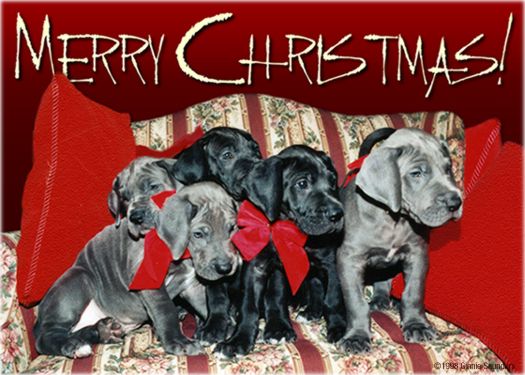
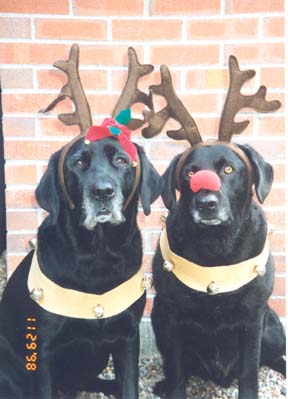
Tonight's my first night as a watchdog,
And here it is Christmas Eve.
The children are sleeping all cozy upstairs,
While I'm guardin' the stockin's and tree.
What's that now---footsteps on the rooftop?
Could it be a cat or a mouse?
Who's this down the chimney?
A thief with a beard---
And a big sack for robbin' the house?
I'm barkin', I'm growlin', I'm bitin' his butt.
He howls and jumps back in his sleigh.
I scare his strange horses, they leap in the air.
I've frightened the whole bunch away.
Now the house is all peaceful and quiet again.
The stockin's are safe as can be.
Won't the kiddies be glad when they wake up tomorrow
And see how I've guarded the tree.

Each Christmas season we hear the stories of the eight tiny, flying reindeer that pull Santa's sleigh all over the world in one night. But what made Santa choose reindeer to help him accomplish this feat? Wouldn't elephants, with their huge flappable ears, make a better choice? Okay, there's the weight factor, but what else makes reindeer the right choice for the jolly North Pole toymaker on his annual voyage? Read on to learn some of the secrets of the world's most famous deer.
Are Reindeer for Real?
While Prancer and Dancer and the gang are the stuff of legend, reindeer are not. These large deer live in northerly climes, in North America, Europe, Asia, and the Arctic. In Eurasia (and the North Pole) they are called reindeer and in North America more commonly caribou, but they are all the same species. The wild herds of Alaska and Canada are known for their mass migrations, while large numbers of those in Eurasia are domesticated, raised for fur, meat, milk, and as work animals. Whether you call them reindeer or caribou, one thing is certain: they are physically well suited to pull a sleigh full of toys and a right jolly old elf.
Questions and Antlers
We've seen the pictures and we know that Santa's reindeer -- Dasher and Dancer and Blitzen and the rest -- sport antlers. Does this mean that all of them (even Vixen?) are males? Not exactly -- in fact, it almost means the opposite. Reindeer and caribou are unique among deer in that the females grow antlers, too. And even more interesting is the fact that the females retain their antlers from one spring till the next, while mature males shed their antlers in the fall -- and are unadorned on Christmas Eve. So the creatures that pull Santa's sleigh must be females or youngsters. Of course, it's entirely possible that a male reindeer with the power to fly also has the power to keep his antlers through the holidays.
All-Terrain Feet
The all-terrain vehicle enables humans to traverse rough, muddy, snowy, or icy terrain. The caribou or reindeer has it beat: it has an all-terrain foot. The animal's remarkable hoof actually adapts itself to the season -- becoming a sort of ice skate in the winter and sneaker in spring. The caribou of North America can run at speeds of almost 50 miles per hour and may travel 3,000 miles in a year. Luckily, the animal is helped along by its amazingly adaptable footpads. In the summer, when the tundra is soft and wet, the footpads become spongy like the soles of tennis shoes and provide extra traction. In the winter, when snow and ice coat the North, the pads shrink and firm up, while the rim of the hoof, like an ice skate's blade, bites into the ice and crusted snow to keep the animal from slipping. Sounds like the perfect footwear for an animal that needs to come to a flying stop on an ice-encrusted rooftop in the dark of the night!
Fur Float
Given its geographic preferences, a reindeer has to have a pretty warm coat. In fact, the coat has two layers of fur, a dense woolly undercoat and longer-haired overcoat. The outer coat consists of hollow, air-filled hairs that give the animal such buoyancy when it enters water that only the lower two-thirds of its body submerges. A caribou or reindeer swims with ease and good speed, and migrating herds will not hesitate to swim across a large lake or broad river. If Santa ever decides to take to the seas rather than the air, he is in good hands!
What in the world
do leaping lords, French hens, swimming swans,
and especially the partridge
who won't come out of the pear tree have to do
with Christmas?
From 1558 until 1829, Roman Catholics in England
were not permitted to
practice their faith openly. Someone during that
era wrote this carol as
a catechism song for young Catholics. It has two
levels of meaning: the
surface meaning plus a hidden meaning known only
to members of their
church. Each element in the carol has a code word
for a religious reality
which the children could remember.
* The partridge in a pear tree was Jesus Christ.
* Two turtledoves were the Old and New
Testaments.
* Three French hens stood for faith, hope and
love.
* The four calling birds were the four gospels of
Matthew, Mark, Luke & John.
* The five golden rings recalled the Torah or
Law, the first five books of
the Old Testament.
* The six geese a-laying stood for the six days
of creation.
* Seven swans a-swimming represented the
sevenfold gifts of the Holy Spirit:
Prophesy, Serving, Teaching, Exhortation,
Contribution, Leadership, and Mercy.
* The eight maids a-milking were the eight
beatitudes
* Nine ladies dancing were the nine fruits of the
Holy Spirit: Love, Joy, Peace,
Patience, Kindness, Goodness, Faithfulness,
Gentleness, and Self Control.
* The ten lords a-leaping were the ten
commandments.
* The eleven pipers piping stood for the eleven
faithful disciples.
* The twelve drummers drumming symbolized the
twelve points of belief in the
Apostles' Creed.

Snow
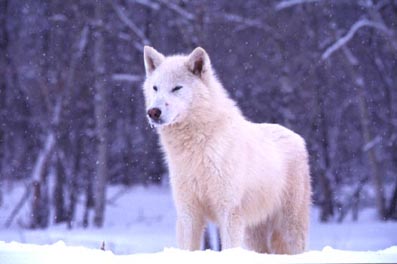
It won't be long before we'll all be there with snow
Snow
I want to wash my hands, my face and hair with snow
Snow
I long to clear a path and lift a spade of snow
Snow
Oh, to see a great big man entirely made of snow
Where it's snowing
All winter through
That's where I want to be
Snowball throwing
That's what I'll do
How I'm longing to ski
Through the snow-oh-oh-oh-oh
Those glist'ning houses that seem to be built of snow
Snow
Oh, to see a mountain covered with a quilt of snow
What is Christmas with no snow
No white Christmas with no snow
Snow
I'll soon be there with snow
I'll wash my hair with snow
And with a spade of snow
I'll build a man that's made of snow
I'd love to stay up with you but I recommend a little shuteye
Go to sleep
And dream
Of snow

ANCHORAGE, Alaska - With the help of his kids and neighbors, Billy Ray Powers built more than just a snowman — they've dubbed his 16-plus-foot-tall creation "Snowzilla."
After using up all the snow in the family's yard, they turned to neighbors' yards and carried buckets on sleds. They hand-packed the snowman like an ice-cream cone.
"It's solid ice," he said. "I put the arms in with my power drill."
It took a month to complete the project. It was too big to use buttons for its eyes, so Snowzilla gazes over the neighborhood from beer bottles.
Powers says the project took on a life of its own as it got bigger and bigger. Now Snowzilla is attracting plenty of sightseers.
"People stop by, and they're just flabbergasted," said neighbor Darrell Estes. "They walk up and knock on it to make sure it's real snow, not Styrofoam."
Chocolate Peppermint Pizzelle From Food Network Kitchens
Recipe Summary
Difficulty: Medium
Prep Time: 30 minutes
Cook Time: 15 minutes
Yield: 18 sandwiched cookies
User Rating:
1 1/4 cups all-purpose flour
1/4 cup unsweetened cocoa powder
1 1/2 teaspoons baking powder
1 teaspoon ground cinnamon
1/2 teaspoon finely grated orange zest
1/4 teaspoon fine salt
3 large eggs, at room temperature
1 cup granulated sugar
1/2 cup (1 stick) unsalted butter, melted, cooled to room temperature
Vegetable oil spray
Confectioners' sugar, for dusting cookies
Filling:
12 ounces semisweet chocolate
4 tablespoons unsalted butter
1/2 teaspoon mint extract
Whisk the flour, cocoa, baking powder, cinnamon, orange zest, and salt together in a large bowl.
In another medium bowl, briskly whisk the eggs, sugar and melted butter together until smooth and evenly combined.
Make a well in the center of the dry ingredients and pour in the egg mixture. Gradually whisk the liquid into the flour to make a thick batter. When the pizzelle batter starts to clump up in the whisk, switch to a rubber spatula to finish mixing it together. (If you have a large pastry bag, put a big round tip in it, and fill with the pizzelle batter.)
Preheat a pizzelle iron until a drop of water sizzles on the hot surface, about 10 minutes. Lightly spray the hot surface with nonstick cooking spray. Pipe or spoon about a tablespoon of the batter into the center of each cookie imprint. Close the iron and cook until whiffs of steam comes from the iron, about 30 to 45 seconds. Open and remove cookie from the iron, cool on a rack. Repeat with remaining batter.
To make the filling:
Put the chocolate and butter in a microwave safe bowl. Cover and microwave on medium power until soft and melted, about 3 minutes depending on the power of your oven; stir until smooth. Alternatively, put the chocolate in a heatproof bowl. Bring a saucepan filled with 1-inch or so of water to a very slow simmer; set the bowl on the pan (without touching the water). Stir occasionally until melted and smooth. Stir in mint extract.
To serve pipe a tablespoon of the mint filling into the center of half the cookies. Top with another cookie and press to sandwich them together. Serve now or keep tightly covered for up to 1 week.

Honor, Duty, Love, Personal Accountability.


 Posts
All Comments
Posts
All Comments